



iGaming has become one of the most compelling digital investment opportunities in entertainment. The market is growing, regulation is making the industry easier to understand and navigate, and demand is being shaped by the same forces driving the wider digital economy: mobile-first behaviour, real-time engagement, personalisation, and the fight for user attention. For investors, the appeal isn’t only player demand but also the technology, infrastructure, data, and operating systems that turn demand into durable business value.
From the outside, iGaming can still look like an industry built on chance: unpredictable players, volatile match results, traffic spikes, shifting regulation, and revenue that only seems to move with major tournaments like the World Cup. Luck is part of the player experience; uncertainty is what makes the product exciting. But confusing the player’s thrill with the operator’s business model is where outsiders misread the sector.
This is where GR8_TECH has a clear view of the industry. As a platform provider working behind the scenes of iGaming operations, the company sees that sustainable growth comes from systems: localised products, reliable payments, automated risk management, real-time data, player segmentation, retention mechanics, and infrastructure that holds during critical moments. In other words, iGaming may sell excitement, but as a business, it rewards preparation, discipline, and execution.
A Market Too Big to Call a Gamble
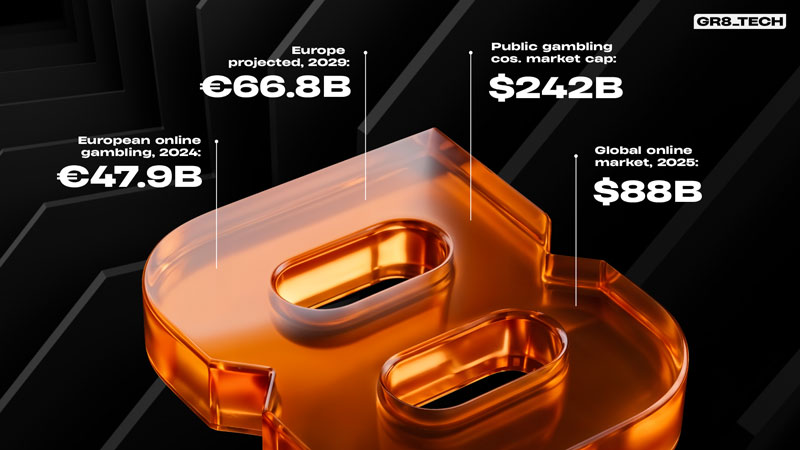
The global online gambling market was valued at $88bn in 2025 and is projected to reach $202.8bn by 2033. Public markets also show substantial value across the gambling ecosystem: 55 publicly traded gambling companies have a combined market capitalisation of roughly $242bn, with online-first, technology-led businesses accounting for tens of billions in public value.
Strong infrastructure turns player intent into actual revenue
Regulated markets show the same trend. In the US, iGaming reached $10.74bn in 2025, up 27.6 percent year over year. In Europe, online gambling generated €47.9bn in 2024 and is projected to reach €66.8bn by 2029. iGaming is no longer a speculative corner of entertainment, but a fast-scaling digital market where value increasingly belongs to the operators and technology providers that can execute.
Two Ways to Enter the iGaming Opportunity
For business people, the opportunity isn’t limited to becoming the next big casino brand. iGaming has two main entry points: B2C, where companies operate directly toward players, and B2B, where companies sell technology, content, data, payments, acquisition, or infrastructure that operators must have to compete.
The B2C route is the most straightforward. An operator owns the brand, the players, and the revenue strategy. Success here requires localised products, reliable payments, strong CRM, risk management, compliance, sports book and casino content, and a platform that can handle loads of traffic. For these businesses, GR8_TECH can act as the technology partner behind the operation, helping them launch faster, localise smarter, and scale with more control.
The B2B route gives companies a way to enter iGaming without becoming operators themselves. Payment providers, affiliate platforms, media businesses, game suppliers, data providers, marketplaces, and regional tech firms can add betting or casino capabilities to their existing offer and sell them through their own ecosystem.
Rather than spending years building the infrastructure from scratch, they can start with ready-made technology. In this model, GR8_TECH provides the platform layer, while the partner owns the client relationship, positioning, and commercial upside.
“Building a serious iGaming platform takes years, experienced people, constant investment, and many lessons learned. So for most operators, starting with ready technology is the smarter business decision until your growth justifies owning the infrastructure yourself,” said Oleksandr Feshchenko, CEO at GR8_TECH.
When Systems Turn Inefficiency Into Revenue
A recent GR8_TECH’s payment-routing case shows how quickly operational systems can translate into revenue impact. A large multi-brand iGaming operator in Eastern Europe was losing revenue because too many player deposits were being sent to payment providers that were not well matched to the card’s issuer country, currency, BIN range, transaction amount, or card scheme.
GR8_TECH helped the operator replace static payment allocation with rule-based routing. Instead of sending deposits through fixed payment paths, each transaction could be automatically routed to the provider most likely to approve it. The operator’s payments team could also adjust routing by BIN, issuer country, currency, amount, and Visa or Mastercard scheme without additional development.
Afterwards, USD card deposit approval rates increased by 25 percent, while EUR approval rates rose by 12 percent. More importantly, the uplift remained stable over the following months as the operator refined its routing logic. The case shows that iGaming growth is often about making the existing funnel work harder. Even small improvements in payment approvals can affect first-time deposits, retention, revenue predictability, and marketing ROI.
“Payment performance signals how efficiently an iGaming business operates. If players want to deposit but the payment fails, the operator loses revenue and wastes the cost of acquiring that player. Strong infrastructure turns player intent into actual revenue,” said Feshchenko.
What to Watch Before Entering iGaming
Like any fast-growing industry, iGaming comes with challenges. The first is market complexity. Player behaviour, payment preferences, content demand, acquisition channels, currency expectations, and retention triggers can vary sharply by region. What works in one market may underperform in another if the product, payments, CRM, and user experience are not adapted locally. Success depends less on copying a proven model and more on building an operating system that can localise quickly, learn from real-time data, and adjust before inefficiencies become expensive.
The second challenge is competition. Operators compete not only with other betting brands, but with every digital product fighting for user attention, from streaming platforms to mobile games and social media. That raises the bar for user experience, personalisation, speed, and retention. iGaming is an engagement business, not just a betting business.
The third challenge is execution. Small operational gaps can quickly become revenue losses: failed deposits, slow product launches, weak retention campaigns, poor risk controls, or downtime. For investors and business builders, this is also where the opportunity becomes clearer. Many of these risks can be reduced with experienced teams, proven infrastructure, and a platform built for scale. iGaming rewards companies that are ready before traffic arrives, not those fixing problems after revenue has already been lost.
Luck Creates Moments. Systems Build Businesses.
iGaming rewards the same qualities that define the strongest businesses in any digital market: precise strategy, market understanding, reliable technology, disciplined execution, and high performance during peak demand. The companies that win aren’t the ones that attract attention, but the ones that convert it efficiently, retain it intelligently, and scale it reliably.
It’s also a high-frequency, data-rich, technology-driven entertainment market where small operational advantages can compound into meaningful business value. The player experience may be built around luck, but the businesses worth backing are built on systems.